JellyFil Official Website › Articles › The testosterone claim
The testosterone claimTribulus Terrestris And The Testosterone Claim
Tribulus terrestris is the eighth name on this label, and it is sold almost everywhere on a claim that it raises testosterone. The two placebo-controlled human trials that tested that specific claim directly did not find it.
A 2005 trial in young men found no change in testosterone, androstenedione or luteinizing hormone at either of two doses. A 2007 trial in elite rugby players found no strength or body-composition advantage over placebo and no change in the urinary testosterone-to-epitestosterone ratio. The same two researchers behind the 2005 trial later reviewed the entire tribulus literature and called the androgen-enhancing claim, in their own words, outdated. This article works through what the trials actually tested, what the review concluded, and what that means for an ingredient sharing an 82 mg blend on this bottle.
Where tribulus sits on this panel
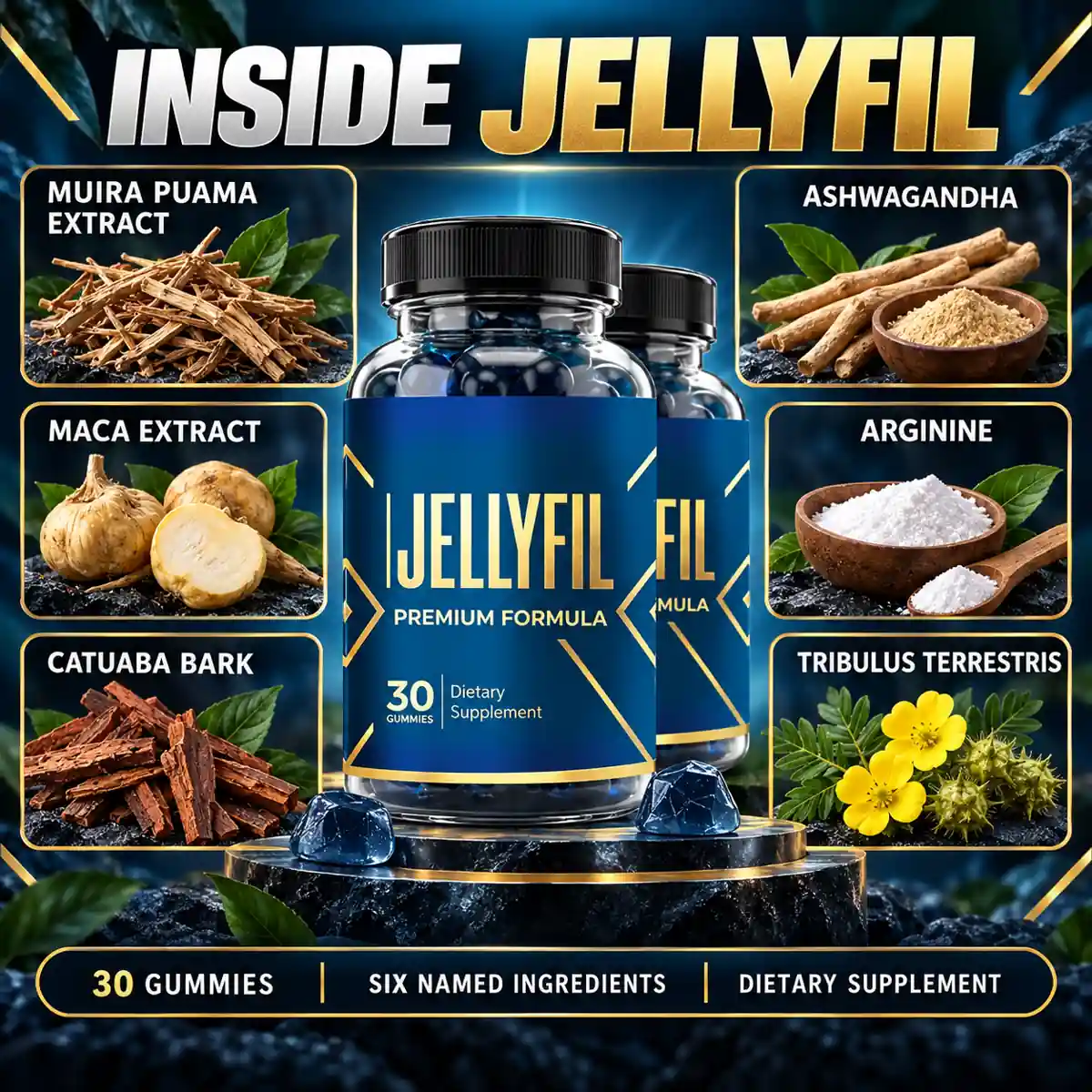
The JellyFil Supplement Facts panel lists nine names inside one Proprietary Blend of 82 mg, in descending order of share: muira puama first, maca second, catuaba third, then green tea extract, caffeine, ashwagandha, L-arginine, tribulus terrestris and horny goat weed last. Tribulus sits eighth, meaning the label's own ordering convention places it among the smaller shares of the blend, ahead of only horny goat weed.
Its label position is a secondary question next to the one this article is actually about: what does tribulus terrestris do, according to the trials that have directly tested its most-repeated claim. That claim, in one sentence, is that tribulus raises testosterone and, through that, libido and physical performance. It is one of the oldest and most widely repeated claims in the entire supplement category, and it is also one of the more directly testable ones, because testosterone is a blood measurement rather than a subjective rating.
JellyFil is a dietary supplement and not a treatment for anything. Nothing here is medical advice. A hormone level that concerns you is a conversation for a doctor and a blood test, not a gummy.
The claim that built this ingredient's reputation
Tribulus terrestris is a spiny, low-growing plant found across warm climates worldwide, used in both Ayurvedic and traditional Chinese medicine for a range of purposes long before it entered the Western sports-supplement and men's-vitality markets in the 1990s. Its modern reputation rests almost entirely on the idea that its steroidal saponins, chiefly a compound called protodioscin, raise the body's own testosterone production, which supplement marketing then links to libido, muscle gain and general vitality in one step.
That is a specific, mechanistic claim, and mechanistic claims are exactly the kind that a randomised, placebo-controlled trial with a blood test can check directly. Two such trials exist, run roughly a decade apart, in different populations, by different research groups, and both went looking for the same thing: a measurable change in androgen hormones after a period of tribulus supplementation.
The 2005 trial in young men
Neychev and Mitev, published in the Journal of Ethnopharmacology in 2005, ran a randomised, placebo-controlled trial specifically to test whether tribulus terrestris extract influences androgen metabolism in young men. Twenty-one healthy men aged 20 to 36 were split into three groups of seven: one taking 10 mg per kilogram of body weight of tribulus extract daily, one taking 20 mg per kilogram, and a placebo group, each for four weeks. Serum testosterone, androstenedione and luteinizing hormone were measured before treatment and at five points during it.
| Hormone measured | Low-dose group | High-dose group | Placebo group |
|---|---|---|---|
| Testosterone | 15.75 nmol/l | 16.32 nmol/l | 17.74 nmol/l |
| Androstenedione | 1.93 ng/ml | 2.03 ng/ml | 1.95 ng/ml |
| Luteinizing hormone | 4.66 U/l | 4.10 U/l | 4.17 U/l |
Mean values at the end of the four-week trial. None of the three hormones differed significantly between either tribulus group and placebo, and all values sat within the normal range throughout.
The authors' own conclusion is worth quoting directly: the results “anticipate that Tribulus terrestris steroid saponins possess neither direct nor indirect androgen-increasing properties.” That is a plain, direct rejection of the exact mechanism the ingredient is most often sold on, from a trial specifically designed to test it, at doses considerably higher, relative to body weight, than a share of an 82 mg proprietary blend could plausibly provide.
The 2007 trial in elite rugby players
Rogerson and colleagues, published in the Journal of Strength and Conditioning Research in 2007, took a different but related question to a different population: twenty-two elite Australian rugby league players, match-paired and randomly assigned in a double-blind design to either 450 mg a day of a tribulus terrestris extract or a placebo, alongside five weeks of structured preseason resistance training. The trial measured muscular strength, fat-free mass and the urinary testosterone-to-epitestosterone (T/E) ratio, the same ratio anti-doping authorities monitor as an indirect marker of anabolic steroid use.
Strength and fat-free mass both increased significantly over the five weeks in both groups, as heavy resistance training would be expected to produce on its own, and there was no significant difference between the tribulus group and the placebo group in either measure. The urinary T/E ratio did not differ between groups either. The authors concluded plainly that tribulus “did not produce the large gains in strength or lean muscle mass that many manufacturers claim,” and that it did not alter the T/E ratio enough to place an athlete at any anti-doping risk — which is reassuring for a different reason than the one the marketing usually offers, since it means the ingredient is not doing enough to a real androgen marker to trip a drug test in either direction.
Order JellyFil
Nine names on the printed panel, 82 mg total, and 60 days from purchase to decide.
Two bottles $158 · six bottles $294
Order JellyFilWhat the 2016 review concluded
Eleven years after their own 2005 trial, Neychev and Mitev returned to the subject with a full literature review, published in the Journal of Ethnopharmacology in 2016, searching every major scientific database for phytochemical, pharmacological and traditional-use studies of tribulus terrestris published between 1968 and 2015. Their aim was explicit: to critically reassess the widely held view of tribulus as an androgen-enhancing botanical.
The review's conclusion is unambiguous. Analysing the phytochemical and pharmacological evidence in both humans and animals, the authors found that the hypothesis that tribulus's pro-sexual or pro-erectile effects are due to androgen-enhancing properties is, in their words, “at best, inconclusive,” and that a comprehensive review of the available evidence “proved this hypothesis wrong.” They go further, calling the deep-seated traditional focus on androgen enhancement “outdated” and “incapable of accommodating the emerging evidence.”
What is left of the aphrodisiac claim
The same review does not conclude that tribulus does nothing. It points toward a different, more recent line of evidence: experimental studies in animals suggesting possible endothelium- and nitric-oxide-dependent mechanisms, the same broad category of blood-vessel and blood-flow pathway that several prescription treatments for erectile dysfunction act on, rather than a hormonal one. That is a genuinely different claim from “raises testosterone,” it is preclinical rather than confirmed in human trials, and it is a plausible reason a plant with no measurable hormonal effect might still carry a traditional reputation for sexual benefit through an entirely different route.
It is worth being precise about what that leaves standing and what it does not. It does not support a testosterone claim; two placebo-controlled human trials looked for one directly and did not find it, and the researchers who ran one of them said so in their own words twice, eleven years apart. It leaves open a different, unconfirmed, non-hormonal mechanism that has not yet been tested in a human trial for a sexual outcome.
What this means for a share of an 82 mg blend
Both trials above tested tribulus terrestris alone, at doses either scaled to body weight (10 to 20 mg/kg, roughly 700 mg to 1,600 mg a day for a typical adult male) or given as a flat 450 mg daily dose. Tribulus is the eighth of nine names sharing this product's 82 mg total, behind seven other extracts in the label's descending-weight order, which means whatever amount it contributes here sits well under the smaller of those two trial doses.
That arithmetic matters less here than it does for some other names on this panel, because the trials in question found no effect at their higher, standalone doses in the first place. A smaller amount of an ingredient that did not move the needle on testosterone at 450 mg to over a gram a day is not a meaningfully different proposition on the specific claim these trials tested. The gap between trial dose and blend share, in other words, is not the interesting part of the tribulus story on this label; the interesting part is that the claim itself did not survive being tested.
The wider point about a widely repeated claim
Tribulus terrestris is not a dangerous ingredient, and nothing in either trial above reported an adverse effect from taking it. The point of this article is narrower and, this website thinks, more useful: one of the single most repeated claims in the entire men's-vitality category, that tribulus raises testosterone, was built almost entirely on marketing repetition and traditional reputation rather than on the trials that exist to test it, and the researchers most associated with investigating that specific claim ended up rejecting it twice, in two different studies, over more than a decade.
That is worth knowing before reading any ingredient claim in this category at face value, on this label or any other. A plant can have a long traditional history, a real place in a formula, and no measurable effect on the specific mechanism its marketing invokes, all at once, and the only way to tell the difference is to read the trial rather than the bottle.
The two ingredients on this panel with no human trials at all, muira puama and catuaba, are covered in full in this website's article on the two tonic barks, and the one ingredient here with a printed amount of its own is covered in the article on the 5 mg of caffeine.
- Neychev VK, Mitev VI. The aphrodisiac herb Tribulus terrestris does not influence the androgen production in young men. J Ethnopharmacol. 2005;101(1-3):319-323. PMID 15994038. https://pubmed.ncbi.nlm.nih.gov/15994038/
- Rogerson S, Riches CJ, Jennings C, Weatherby RP, Meir RA, Marshall-Gradisnik SM. The effect of five weeks of Tribulus terrestris supplementation on muscle strength and body composition during preseason training in elite rugby league players. J Strength Cond Res. 2007;21(2):348-353. PMID 17530942. https://pubmed.ncbi.nlm.nih.gov/17530942/
- Neychev V, Mitev V. Pro-sexual and androgen enhancing effects of Tribulus terrestris L.: Fact or Fiction. J Ethnopharmacol. 2016;179:345-355. PMID 26727646. https://pubmed.ncbi.nlm.nih.gov/26727646/