JellyFil Official Website › JellyFil Supplement Facts
JellyFil Supplement FactsJellyFil Supplement Facts: The Printed Panel, Line By Line
Serving size is one gummy and a bottle holds thirty of them.
Ten calories, 3 g of carbohydrate, 3 g of it added sugar at 6% of a daily value, and 4 mg of sodium. Then one Proprietary Blend of 82 mg, which the panel states is equivalent to approximately 567 mg of dry powders, holding nine extracts of which only caffeine at 5 mg carries a figure.
Everything on this page is transcribed from the label artwork that ships with this product. Nothing is summarised and nothing is rounded.
The JellyFil label as it is printed
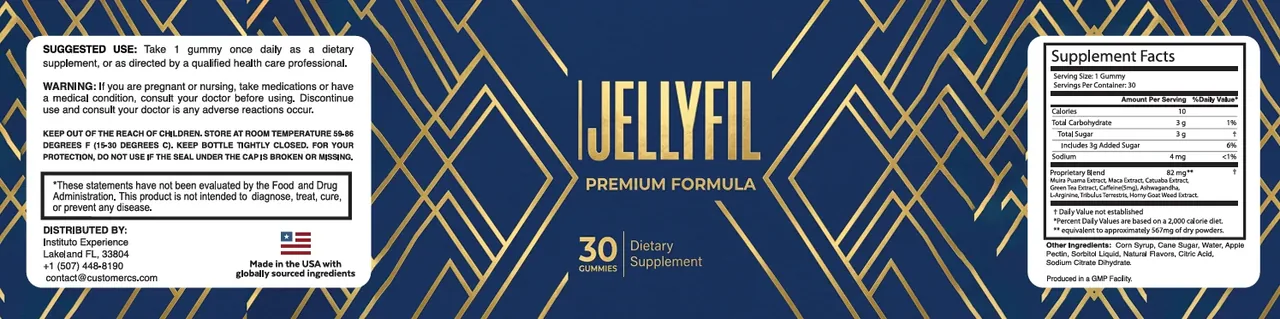
Three blocks across one wrap. Suggested use, the warning and the distributor's details on the left; the brand panel in the middle with the thirty-gummy count; the Supplement Facts box and the other-ingredients line on the right.
The JellyFil nutrition lines, transcribed
| Line | Amount per serving | Percent daily value |
|---|---|---|
| Calories | 10 | |
| Total Carbohydrate | 3 g | 1% |
| Total Sugar | 3 g | † |
| Includes Added Sugar | 3 g | 6% |
| Sodium | 4 mg | <1% |
| Proprietary Blend | 82 mg | † |
Serving size: 1 gummy. Servings per container: 30. The dagger marks a line for which no daily value has been established, and the asterisked note on the panel reads that percent daily values are based on a 2,000 calorie diet.
Three grams of added sugar a day is small in absolute terms and it is still the line to notice if you are counting carbohydrate closely, because it arrives every day for as long as the routine lasts. Over a six-bottle pack that is 180 gummies and 540 g of sugar.
What sits inside the JellyFil proprietary blend
| Order on the panel | Extract | In the advertising |
|---|---|---|
| 1 | Muira Puama Extract | Yes |
| 2 | Maca Extract | Yes |
| 3 | Catuaba Extract | Yes |
| 4 | Green Tea Extract | No |
| 5 | Caffeine | No |
| 6 | Ashwagandha | Yes |
| 7 | L-Arginine | Yes |
| 8 | Tribulus Terrestris | Yes |
| 9 | Horny Goat Weed Extract | No |
The blend line reads: Proprietary Blend 82 mg, with a footnote that it is equivalent to approximately 567 mg of dry powders.
A proprietary blend is a legal way to declare a group of ingredients under one weight instead of nine. It protects a formula from being copied and it means a buyer can only ever know the ceiling: no extract here exceeds 82 mg, and beyond that the split is the manufacturer's to know.
Caffeine is the exception because the figure is printed inside the line: 5 mg. That single number is the one thing on this panel a buyer can compare with anything else on a shelf.
The JellyFil directions, warning and storage lines, quoted
“Take 1 gummy once daily as a dietary supplement, or as directed by a qualified health care professional.”
“If you are pregnant or nursing, take medications or have a medical condition, consult your doctor before using. Discontinue use and consult your doctor if any adverse reactions occur.”
“Keep out of the reach of children. Store at room temperature 59-86 degrees F (15-30 degrees C). Keep bottle tightly closed. For your protection, do not use if the seal under the cap is broken or missing.”
The carton also carries “Produced in a GMP Facility” and “Made in the USA with globally sourced ingredients”, and names the distributor as Instituto Experience, Lakeland FL, 33804 with the same telephone number this shop publishes, +1 (507) 448-8190.
How to read the JellyFil proprietary blend line
A blend line has a fixed grammar and it is worth learning once. The name comes first, then one weight for the whole group, then the ingredient names beneath it in descending order of share. Here that reads Proprietary Blend, 82 mg, then nine names beginning with muira puama.
Three things follow. The first name is the largest share, which is why muira puama leads this website’s ingredient page even though it has the thinnest human evidence of the nine. The last name is the smallest share, which here is horny goat weed. And every share sums to the stated total, so no extract can be above 82 mg and the eight sharing 77 mg average under ten milligrams each.
The footnote matters as much as the number. Equivalent to approximately 567 mg of dry powders is the manufacturer stating a concentration ratio: roughly seven parts raw plant reduced to one part extract. That is a real multiplier and the most generous honest reading of this panel, which is why it is printed on every page of this website that quotes the 82 mg.
The limits of what a JellyFil panel can tell you
A Supplement Facts panel is a declaration, not a test result. It states what the manufacturer intends the product to contain and it is produced long before the product reaches a buyer. Nothing on it is an assay of the bottle in your hand, and that is true of every supplement panel in the United States rather than of this one in particular.
What that means practically: a panel cannot tell you what a third-party laboratory would find, whether one batch differs from another, or whether anything is present that nobody declared. The last of those is the serious question in this category, and the analytical literature on it is worth reading once. The defence available to a buyer is not a better panel; it is buying from a named channel with a lot number and a refund line.
Lot JEL-26/JE-2310 and certificate reference JEL-2310-26-JE are what this bottle carries for that purpose. What each identifies, and what neither is, is set out on the batch verify page.
JellyFil Supplement Facts: common questions
Does the JellyFil label print an amount for each ingredient?
One amount is printed inside the blend: caffeine at 5 mg. The other eight extracts sit inside a single Proprietary Blend figure of 82 mg, which is a legal way of declaring a group under one weight. It means the ceiling is knowable and the split is not.
What does the JellyFil dry-powder equivalent line mean?
The panel states that the 82 mg is equivalent to approximately 567 mg of dry powders. That is a concentration ratio of roughly seven to one: the manufacturer saying these are extracts rather than ground plant. It is a real multiplier and it is the most generous honest reading of the panel.
How much sugar does one JellyFil gummy carry?
3 g, all of it added sugar, which the panel puts at 6% of a daily value, plus 10 calories and 3 g of total carbohydrate. Over a six-bottle pack that is 180 gummies and 540 g of sugar.
Is the JellyFil panel the same as a certificate of analysis?
No. A panel is a declaration made before the product ships; a certificate of analysis is a laboratory result on a batch. This bottle carries certificate reference JEL-2310-26-JE and lot JEL-26/JE-2310, and the batch verify page explains what each one identifies.
Why does JellyFil use apple pectin rather than gelatin?
Pectin is a plant setting agent, which is what makes the vegetarian seal shown on this website consistent with the printed ingredient list rather than at odds with it. It also sets softer, which is why the storage line on the label matters.
Who publishes this JellyFil website?
The sources this page links to. The panel itself is the primary document and it ships with the bottle.
- Kee CL, Ge X, Gilard V, et al. A review of synthetic phosphodiesterase type 5 inhibitors (PDE-5i) found as adulterants in dietary supplements. J Pharm Biomed Anal. 2018;147:250-277. PMID 28903860. https://pubmed.ncbi.nlm.nih.gov/28903860/
More about JellyFil
Order JellyFil with the panel in front of you
Every line above is on the bottle that arrives. 60 days from the date of purchase to decide it was not for you.
Two bottles $158 · six bottles $294 · 60-day money-back guarantee
Order JellyFil From This ShopLot JEL-26/JE-2310 · one a day, 30 to a bottle · ships from the United States