JellyFil Official Website › Articles › The trial dose and the blend dose
The trial dose and the blend doseMaca Root: The Trial Dose And The Blend Dose
Maca is the second name on this label. The human trials that reported an effect from it gave people 1.5 g to 3 g a day, on their own, of maca alone.
The whole JellyFil Proprietary Blend, all nine extracts added together, is 82 mg. That is not a rounding difference; it is roughly a twenty-to-one gap between what a trial dosed and what this gummy’s entire active line weighs. This article walks through the four trials behind maca’s reputation, what dose each one actually used, and what that gap does and does not mean for a bottle that lists maca as one of nine names sharing 82 mg.
Where maca sits on this panel
The JellyFil Supplement Facts panel lists nine names inside one Proprietary Blend of 82 mg, in descending order of share: muira puama first, maca second, catuaba third, then green tea extract, caffeine, ashwagandha, L-arginine, tribulus terrestris and horny goat weed last. A blend's ingredient order is not decoration; by the labeling convention that produces it, the first name carries the largest share and the last carries the smallest, so maca is declared as the second-largest component of a group that together weighs less than a tenth of a gram.
That single fact, more than any study result, is the frame for everything below. Maca root (Lepidium meyenii) is a real plant with a real, if thin, clinical literature behind it. The question this article asks is not whether maca does anything. It is whether the amount of maca a reader can infer from this label bears any resemblance to the amount used in the trials that literature rests on.
JellyFil is a dietary supplement and not a treatment for anything. Nothing here is medical advice. Sexual function that changes suddenly, or that comes with other symptoms, is a conversation for a clinician, not a gummy.
What the maca trials actually gave people
Maca is normally sold and studied as a dried, gelatinized root powder or a comparable dry extract, dosed in grams rather than milligrams. That is worth saying plainly because it is easy to lose in a supplement aisle where most active ingredients are measured in milligrams or micrograms: maca trials work at a scale roughly a thousand times larger.
| Trial | Population | Maca dose used | Duration |
|---|---|---|---|
| Gonzales et al. 2002 | Healthy adult men, 21–56 | 1,500 mg or 3,000 mg/day | 12 weeks |
| Dording et al. 2008 | Adults with SSRI-related sexual dysfunction | 1.5 g or 3.0 g/day | 12 weeks |
| Zenico et al. 2009 | Men with mild erectile dysfunction | 2,400 mg/day | 12 weeks |
| This JellyFil gummy | — | Maca is one of nine names sharing an 82 mg total blend | Ongoing, one gummy a day |
The fourth row is not a trial. It is what the printed panel allows a reader to know: an 82 mg ceiling for all nine extracts combined, with no published split.
Every trial in that table used maca on its own, as the only active ingredient under test, at a dose measured in grams. None of them tested maca as one ingredient inside a multi-herb proprietary blend, and none of them tested a dose anywhere near what a 82 mg total blend could contain for a single name inside it.
The four randomised trials, one by one
Gonzales and colleagues, 2002, ran a 12-week, double-blind, placebo-controlled trial in men aged 21 to 56, comparing 1,500 mg and 3,000 mg of Maca Gelatinizada a day against placebo. Self-reported sexual desire improved from eight weeks onward in the maca groups, and the improvement held even after the researchers controlled for mood scores and for serum testosterone and oestradiol, which did not differ between groups. The finding was specifically about desire, not about erectile function, and the paper is explicit that testosterone was not the mechanism.
Zenico and colleagues, 2009, gave 50 men with mild erectile dysfunction either 2,400 mg of maca dry extract or placebo for 12 weeks. Both groups improved on the standard erectile-function questionnaire, which is a common pattern in trials of this kind, but the maca group improved significantly more (roughly three times the placebo group's gain), and only the maca group showed a significant improvement in the physical and social performance domains of a separate well-being scale.
Dording and colleagues, 2008, ran a small dose-finding pilot in 20 people being treated for depression who had developed sexual dysfunction as a side effect of their SSRI antidepressant, comparing 1.5 g and 3.0 g of maca a day. Only the 3.0 g group showed a statistically significant improvement on the two sexual-function scales used; the 1.5 g group did not reach significance. The authors read that as a possible dose-response signal, though the trial was small and roughly half the participants did not complete it.
A fourth trial the systematic review below includes, in healthy menopausal women, also used a gram-scale dose and is outside the scope of a men's vitality product, but it belongs in the same pattern: every placebo-controlled trial that found an effect from maca used a gram-scale amount of maca alone.
What a systematic review of all four concluded
Shin and colleagues, 2010, searched 17 databases for every randomised trial of maca against placebo for sexual dysfunction and found exactly four that met their inclusion criteria; the three above are among them. Two of the four found a significant positive effect (in healthy menopausal women and in healthy adult men, respectively), one found no effect at all (in healthy competitive cyclists), and the fourth, using the erectile-function index, showed significant improvement in men with erectile dysfunction.
The review's own conclusion is worth quoting rather than summarising: it found "limited evidence for the effectiveness of maca in improving sexual function," and it says plainly that the total number of trials, the total sample size, and the average methodological quality "were too limited to draw firm conclusions," calling for more rigorous studies. That is the honest state of the maca literature fifteen years after that review, and it has not been substantially overturned by a large confirmatory trial since.
The arithmetic: grams in the trial, milligrams in the blend
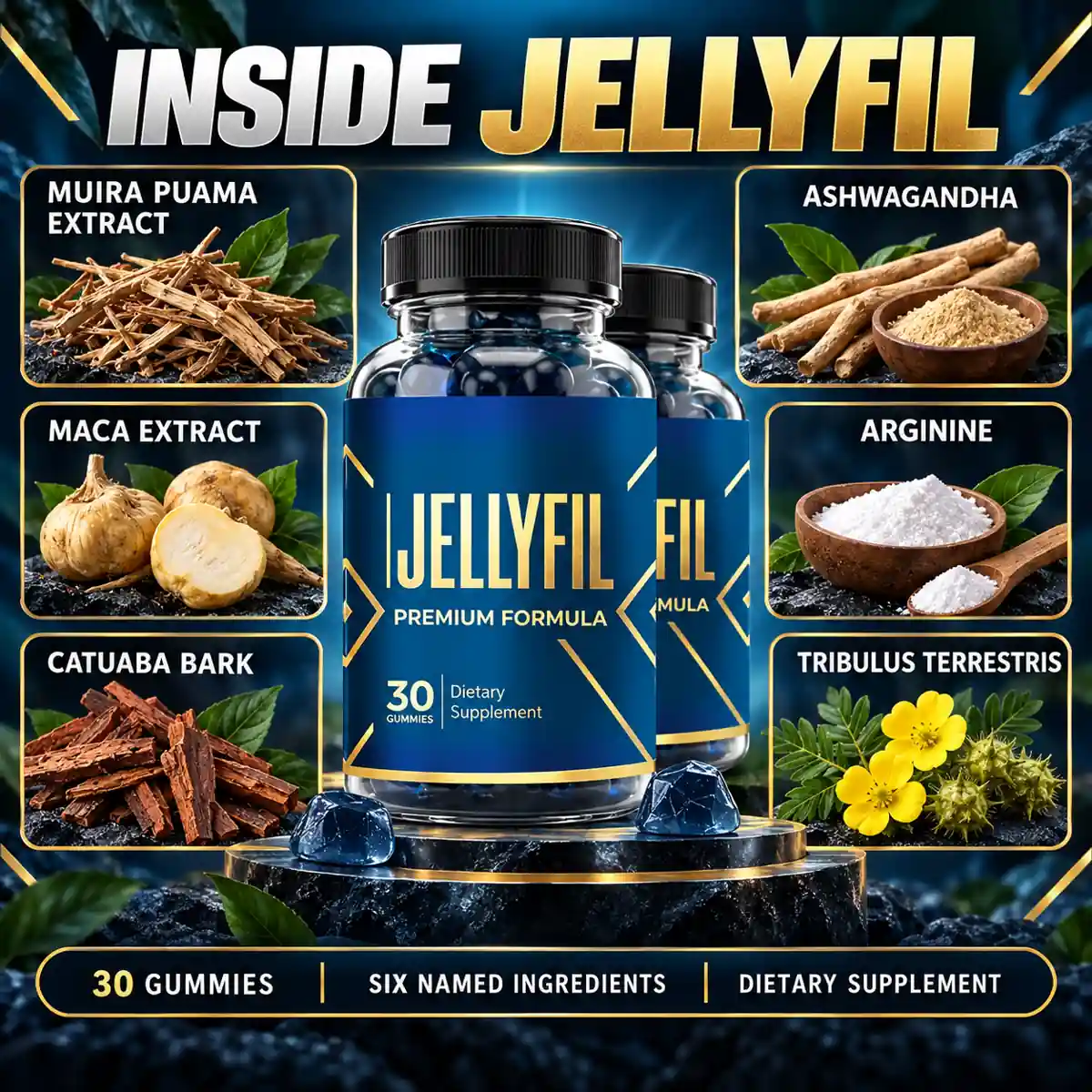
Put the two numbers next to each other. The smallest dose that produced a significant result in any of the four trials above was 1,500 mg. The entire JellyFil blend, all nine extracts combined, including maca, muira puama, catuaba, green tea extract, caffeine, ashwagandha, L-arginine, tribulus terrestris and horny goat weed, totals 82 mg.
Even if maca were, implausibly, the entire 82 mg on its own with nothing left for the other eight names, that would still be roughly 18 times below the lowest trial dose that worked and 37 times below the highest. In reality maca shares that 82 mg with eight other extracts, in a blend where the ingredient order suggests muira puama carries a larger share still. The realistic maca content of one gummy is a small fraction of a milligram-scale total that is already a small fraction of what any trial tested.
This is arithmetic a reader can do without a chemistry background, and it is the single most useful thing this article can hand you: whatever maca does at 1.5 g to 3 g a day, that is not the experiment a proprietary blend at 82 mg total is running.
What the gap does and does not tell you
It does not tell you the gummy contains no maca, or that maca is a bad ingredient to have on a label. The plant has a real, if narrow, clinical record, and being one of nine names in a blend is not fraud; it is how this entire product category is built and labeled, and it is legal.
It does tell you that citing the maca trials as if they describe this product is a mismatch. A marketing page that lists "may improve sexual desire (per clinical study)" beside maca, without naming the dose that study used, is technically citing a real paper while implying a comparison the label's own numbers cannot support. The honest reading is: maca is present, in an amount well below what any trial tested, inside a blend where seven other names compete for the same milligrams.
Nothing about whether to try the product. It changes what you should expect from it, and what question to ask if a seller cites a maca study: at what dose, and does this bottle's ingredient order make that dose plausible?
What evidence for this specific bottle would need to look like
A trial that actually supported this product's maca content would need to test the blend itself, or at minimum disclose the milligram amount of maca inside it and test that exact amount alone. Neither exists for JellyFil, and to the JellyFil team's knowledge neither exists for any proprietary-blend gummy in this category, because a blend's entire commercial logic is built on not disclosing the split.
Absent that, the closest honest substitute is what this article has done: read the trials that exist, note the dose each one used, and set that dose beside the total weight the label allows. That comparison will not tell a reader what the product does. It tells them what claim the product cannot yet support with its own evidence, which is a different and more useful thing to know before paying for it.
If the trial dose is what you are actually after
- Read the ingredient order on any blend before assuming a trial applies to it. A name near the bottom of a short blend is a different proposition from the same name at the top of a long one.
- If a seller's page cites a maca study, ask what dose that study used and whether the label states enough to make that dose plausible. Most proprietary-blend pages will not answer either question, and that silence is itself an answer.
- A single-ingredient maca product that states its gram-scale dose on the label is the more direct way to test what the trials above actually found, separate from anything a nine-name blend is doing.
- None of this is an argument against trying JellyFil for the reasons a buyer already has. It is an argument against expecting it to replicate a 1.5 g to 3 g maca trial, because on the numbers printed here it structurally cannot.
None of the four trials above reported serious adverse effects at the doses used, and maca has a long history as a food in the Andean region it comes from. The caution here is not about safety; it is about expectation, and about reading a blend total before deciding what a single name inside it is likely doing.
Order JellyFil with the blend total in view
82 mg of blend, nine names, and 60 days from purchase to decide.
Two bottles $158 · six bottles $294 · 60-day money-back guarantee
Order JellyFil From This ShopLot JEL-26/JE-2310 · one a day, 30 to a bottle · ships from the United States
The wider point about grams-scale herbs in milligram-scale blends
Maca is not the only herb in this category with a clinical literature built at gram-scale doses that gets sold inside milligram-scale blends. It is a pattern worth watching for on any label: an ingredient whose published trials used one to three grams a day, sitting inside a proprietary blend whose entire declared weight is under a hundred milligrams.
The fix is not to distrust every blend on sight. It is to ask the arithmetic question before the purchase rather than after: what dose did the studies behind this name use, and does the label's total weight make that dose plausible for this product. For maca, on this label, the honest answer is that it does not, and that is worth knowing going in.
The same question, asked of a different name on this panel, is behind this website's article on ashwagandha and the trial dose behind it. Muira puama, the name that leads this blend ahead of maca, is covered separately in the article on the two tonic barks and what evidence actually exists for them.
- Gonzales GF, Córdova A, Vega K, et al. Effect of Lepidium meyenii (MACA) on sexual desire and its absent relationship with serum testosterone levels in adult healthy men. Andrologia. 2002;34(6):367-372. PMID 12472620. https://pubmed.ncbi.nlm.nih.gov/12472620/
- Zenico T, Cicero AF, Valmorri L, et al. Subjective effects of Lepidium meyenii (Maca) extract on well-being and sexual performances in patients with mild erectile dysfunction: a randomised, double-blind clinical trial. Andrologia. 2009;41(2):95-99. PMID 19260845. https://pubmed.ncbi.nlm.nih.gov/19260845/
- Dording CM, Fisher L, Papakostas G, et al. A double-blind, randomized, pilot dose-finding study of maca root (L. meyenii) for the management of SSRI-induced sexual dysfunction. CNS Neurosci Ther. 2008;14(3):182-191. PMID 18801111. https://pubmed.ncbi.nlm.nih.gov/18801111/
- Shin BC, Lee MS, Yang EJ, Lim HS, Ernst E. Maca (L. meyenii) for improving sexual function: a systematic review. BMC Complement Altern Med. 2010;10:44. PMID 20691074. https://pubmed.ncbi.nlm.nih.gov/20691074/